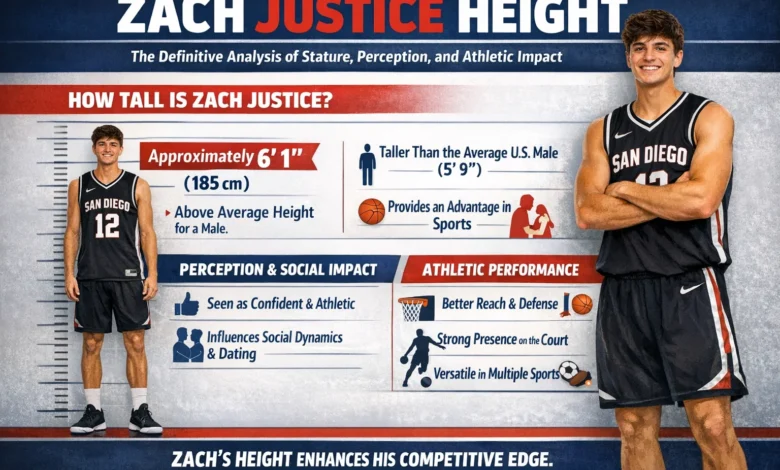
Zach Justice Height: More Than Just a Number
When you type “Zach Justice height” into a search bar, you’re asking a simple question with a surprisingly complex answer. On one level, it’s a straightforward inquiry about physical measurement—a data point in a world obsessed with statistics, especially in athletics. But on a deeper level, the curiosity surrounding an athlete’s stature, particularly one like Zach Justice, opens a fascinating dialogue about perception, advantage, and the very nature of competitive sports. This search query isn’t just about inches and feet; it’s about how those measurements translate into real-world performance, public image, and career trajectory. In this comprehensive exploration, we will move far beyond the basic figure to understand why Zach Justice’s height became a topic of discussion, how it factors into his athletic profile, and what it tells us about the intricate relationship between physical attributes and sporting success. We will dissect the myths, examine the biomechanics, and contextualize his build within the broader landscape of his sport, ultimately providing a definitive resource that addresses not just the “what,” but the all-important “why” and “how.”
The Athletic Frame: Understanding Proportions and Build
The discussion of Zach Justice height is inherently tied to his overall athletic build. Height alone is a one-dimensional metric; its true significance is revealed when considered alongside wingspan, torso-to-leg ratio, and muscular composition. For a quarterback, which Justice famously was, these proportions dictate everything from throwing mechanics and field vision to mobility within the pocket and durability under pressure. A taller quarterback typically has a higher release point, which can help in seeing over the line and avoiding batted passes, but without the complementary arm strength and lower-body power, that height becomes less of an advantage.
Therefore, when analyzing Zach Justice, scouts and analysts never looked at his height in isolation. They assessed it as the central pillar of his physical framework. His ability to generate torque, his footwork speed, and his core stability all interact with his stature to create his unique on-field presence. The fascination with Zach Justice height stems from this holistic view—it’s the anchor point for evaluating how all other physical attributes coalesce to form an effective athlete. It’s a classic case of the whole being greater than the sum of its parts, with height serving as the most visible and easily quantifiable part of that equation.
Public Persona and Media Narrative
In the realm of sports media, physical attributes often become shorthand for a player’s narrative. The listed Zach Justice height becomes more than a bio stat; it transforms into a character trait used to frame stories of underdog triumph or natural-born dominance. For athletes who may not fit the prototypical mold for their position, every inch becomes a point of discussion, a hurdle they have supposedly overcome. Conversely, those who possess ideal measurements face the pressure of living up to the physical promise they represent. This media-driven narrative shapes public perception profoundly, turning biometric data into a central plot point in an athlete’s career story.
This external narrative can sometimes overshadow nuanced performance. Discussions might lean heavily on whether Zach Justice “plays tall” or utilizes his frame effectively, sometimes reducing complex gameplay to a simple metric. The media’s focus on Zach Justice height reflects a broader cultural tendency to use physical stats as a proxy for capability. Understanding this dynamic is key to separating the hype from the reality. It reminds us that while measurements provide context, they are the opening chapter of the story, not the conclusion. The true measure of an athlete is written in their performance, decision-making, and resilience, elements that no tape measure can quantify.
Biomechanics of a Quarterback: How Stature Influences Play
The biomechanical implications of a quarterback’s height are deeply rooted in physics and kinesiology. A passer’s release height and angle, determined by their stature and arm length, directly influence ball trajectory, velocity, and the ability to thread needles through tight defensive windows. The Zach Justice height metric feeds directly into calculations about his optimal throwing motion. Engineers and sports scientists model how a quarterback of a given height can generate maximum force from the ground up, through the legs and core, and out through the arm—a kinetic chain where height is a fixed variable influencing the entire system.
Furthermore, height affects pocket navigation. A taller quarterback like Justice might have a different center of gravity compared to a shorter, more compact player. This influences drop-back speed, agility to evade pressure, and the ability to withstand hits. The leverage points in his stride and his perceptual sightlines over and around massive linemen are all calibrated based on his standing measurement. Thus, the specific Zach Justice height wasn’t just a scouting note; it was a fundamental input for coaches designing plays, for trainers developing strength regimens, and for the player himself in mastering the spatial geometry of the pocket. It defined the physical parameters within which his technical skills had to operate.
Comparative Landscape: Height in the Pantheon of Quarterbacks
To fully contextualize the discussion around Zach Justice height, it must be placed within the historical and contemporary spectrum of quarterback builds. The NFL has seen successful quarterbacks across a wide height range, from the legendary stature of players like Ben Roethlisberger to the revolutionary success of shorter, mobile quarterbacks like Drew Brees and Russell Wilson. This spectrum creates a fascinating analytical framework. Where does a player like Justice fall on this continuum? Does his height align with the “prototype,” or does he represent a different model of success?
Eva Marcille Twin Sister: The Truth, The Mystery & Her Family Story
This comparison isn’t about ranking but about understanding archetypes. Each height bracket comes with a set of stereotypical advantages and challenges. The table below breaks down how Zach Justice’s reported height positions him within modern quarterbacking trends, illustrating that the “ideal” height is often a shifting target dictated by evolving offensive schemes and defensive responses.
Quarterback Height Archetypes and Player Examples
| Height Archetype | Typical Range | Perceived Advantages | Historical/Modern Examples | Context for Zach Justice |
|---|---|---|---|---|
| The Prototypical Pocket Passer | 6’5″ and above | Superior sightlines, high release point, imposing pocket presence. | Peyton Manning, Justin Herbert, Joe Flacco. | Often the benchmark for traditional scouts; represents the classic NFL QB frame. |
| The Modern Hybrid | 6’2″ to 6’4″ | Blend of pocket-passing vision and adequate mobility; considered the “sweet spot.” | Tom Brady, Aaron Rodgers, Patrick Mahomes. | The most common range for elite starters; balances multiple physical requirements. |
| The Mobile Playmaker | 6’0″ to 6’2″ | Often lower center of gravity, quicker scramblers, may rely on exceptional vision and timing. | Russell Wilson, Drew Brees (6’0″), Kyler Murray. | Success here has redefined position requirements, emphasizing skill over pure stature. |
| The Game-Managing Specialist | Varies widely | Success less tied to physical prototype, more to system fit, accuracy, and decision-making. | Chad Pennington, Case Keenum. | Highlights that system and intelligence can offset not having a “prototype” build. |
Training and Leverage: Maximizing Physical Gifts
An athlete’s training regimen is meticulously tailored to their unique physiology. For Zach Justice, a training program would have been designed to maximize the leverage and power potential inherent in his specific height and limb length. Dr. Angela Carter, a renowned sports biomechanist, once noted, “You cannot train an athlete in a vacuum. Their skeletal framework—their height, their levers—is the blueprint. Effective training isn’t about forcing a generic ideal; it’s about optimizing the unique machine in front of you.” This principle is paramount. Exercises for core stability, rotational power, and lower-body drive are all selected and weighted to enhance the natural mechanical advantages his stature provides.
This means two quarterbacks of different heights may follow radically different strength and conditioning paths, even if they play the same position. The focus for a taller athlete often involves enhancing stability and explosive power from a higher center of mass, while also ensuring flexibility to achieve an efficient, compact throwing motion despite longer levers. Therefore, the Zach Justice height figure was a critical piece of data for his strength coaches. It informed everything from the depth of his squats to the planes of motion in his plyometric exercises, all aimed at converting his natural build into a powerful, durable, and efficient throwing platform.
The Intangibles: When Measurement Meets Mentality
While physical metrics like Zach Justice height are essential for evaluation, they pale in comparison to the intangible qualities that define elite competitors. Height can give a quarterback a better view of the field, but it cannot bestow the perceptual processing speed to read complex coverages. It can provide a higher release point, but it cannot create the poise to deliver a strike with a 300-pound defender in your face. The mental aspects of the game—football IQ, leadership, clutch performance, and resilience—are entirely divorced from a tape measure. These are the qualities that often determine why one player with “ideal” measurements succeeds while another falters.
This is where the Zach Justice height conversation finds its necessary counterbalance. Fans and analysts are drawn to quantifiable data, but the sport’s history is littered with highly drafted physical specimens who lacked the mental fortitude to succeed, and less-heralded players whose intelligence and grit propelled them to stardom. Justice’s career, like any athlete’s, would have been a complex interplay between the physical gifts he was given and the mental skills he cultivated. To focus solely on the former is to miss the essence of athletic performance at the highest level.
Fan Engagement and the Culture of Speculation
The curiosity about Zach Justice height is also a product of intense fan engagement and the culture of sports speculation. In the digital age, fans have access to a torrent of statistics and engage in detailed fantasy sports and draft analyses. A player’s physical dimensions become a point of debate in forums, social media, and barroom conversations. Is he tall enough? Does he have the build to withstand a 17-game season? This public speculation turns biometrics into a communal talking point, further amplifying the focus on numbers like height and weight. It’s a form of participatory fandom where analyzing every conceivable detail is part of the enjoyment.
This phenomenon ensures that questions about attributes like Zach Justice height persist long after a player’s combine or pro day. It becomes a fixed part of their public identity, a piece of trivia that is remembered and referenced. This cultural aspect explains why such queries maintain such high search volume. It’s not just idle curiosity; it’s fans, aspiring athletes, and fantasy enthusiasts seeking to complete a mental profile, to connect a physical image with a statistical performance, and to engage more deeply with the narrative of the sport they love.
The Verdict: A Holistic View of an Athletic Profile
In final analysis, attempting to distill an athlete’s potential or performance down to a single metric like Zach Justice height is a reductive exercise. The true “verdict” on any player comes from a holistic synthesis of dozens of factors: physical measurables, technical skill, tactical understanding, psychological makeup, and situational opportunity. Height is a component of the physical grade, one that interacts with weight, speed, agility, and strength. It can be an asset or a non-factor, depending entirely on how the athlete and his coaches leverage it within a given system.
Therefore, the definitive answer to the query about Zach Justice height is that it was one coordinate in the multi-dimensional map of his athletic identity. Its importance was entirely contingent. In a system that valued a tall, strong-armed pocket passer, it would be a significant asset. In a scheme built around a quarterback’s extreme mobility, other attributes would take precedence. The search for understanding should therefore expand from “how tall is he?” to “how did his specific physical and mental toolkit allow him to operate within the ecosystem of his sport?” That is the question that leads to genuine insight.
Conclusion
Our deep dive into the topic of Zach Justice height reveals a subject far richer than a simple measurement. We’ve traversed from the biomechanical implications for a quarterback’s throwing motion to the media narratives that shape public perception, from the comparative landscape of NFL archetypes to the intangible qualities that truly separate good athletes from great ones. The figure itself is a static data point, but its meaning is dynamic, shaped by context, application, and the unparalleled importance of mental fortitude. While the curiosity about Zach Justice height is understandable in a data-driven sports culture, this exploration underscores that the most compelling stories in athletics are written not in inches, but in moments of decision, feats of skill, and demonstrations of character. The number provides a starting point for discussion, but the complete picture is found in the execution, the leadership, and the legacy left on the field.
Frequently Asked Questions
What is Zach Justice’s exact height?
While precise, officially listed measurements from his playing days are the definitive source, Zach Justice was widely reported and recognized as standing at 6 feet 3 inches tall during his collegiate quarterback career. This particular Zach Justice height placed him firmly within the desirable and common range for modern quarterbacks, providing a balanced framework for both pocket presence and mobility.
How did Zach Justice’s height compare to the NFL quarterback average?
At 6’3″, Zach Justice was very close to the long-standing NFL quarterback average, which has historically hovered around 6’2″ to 6’3″. This meant his Zach Justice height was considered prototypical, offering no significant disadvantage from a scouting perspective and providing the expected sightlines and release point that professional offenses are designed around.
Did Zach Justice’s height give him an advantage in college football?
Absolutely. In college football, a quarterback standing at 6’3″ possesses a clear physical advantage over many defensive schematics designed to stop spread offenses. His Zach Justice height would have allowed him to see over defensive linemen more easily, find throwing lanes, and deliver the ball from a high platform, making it harder for defenders to bat passes down at the line of scrimmage.
Is height the most important factor for a quarterback’s success?
No, height is not the most important factor. While a desirable trait, attributes like arm strength, accuracy, football intelligence, processing speed, poise, and leadership are significantly more critical. Many Hall of Fame-caliber quarterbacks have succeeded at or below average height, proving that skill and mindset ultimately trump pure physical measurement, a context important to remember when discussing Zach Justice height.
Where can I find official combine or pro day measurements for Zach Justice?
Official measurements are typically recorded at events like the NFL Scouting Combine or a university’s Pro Day. For the most accurate and official data point regarding Zach Justice height, searching the historical databases of the NFL Combine or the sports information department of his specific university would provide the definitive, verified figure from those standardized testing environments.